When you buy through links on our articles, Future and its syndication partners may earn a commission.

The European Space Agency's Hera spacecraft has completed a major deep-space maneuver, setting it on course to rendezvous late this year with the asteroid system targeted by NASA's DART mission back in 2022.
Hera launched on a SpaceX Falcon 9 rocket in October 2024, beginning its voyage to the Didymos binary asteroid system. Hera is designed to make follow-up observations of Dimorphos, the smaller of the two asteroids, which NASA's DART (Double Asteroid Redirection Test) spacecraft slammed into in September 2022.
The Hera spacecraft made a flyby of Mars one year ago, in March 2025, testing its autonomous vision-based navigation and training its cameras on the Martian moon Deimos, while also setting itself on course for the Didymos system.

Hera is now set up for its rendezvous with the asteroids in November 2026, thanks to a campaign of carefully planned engine burns that it performed in February and March.
"We divided the deep-space maneuver into three engine burns, plus one much smaller correction maneuver, carried out over a period of around four weeks," Francesco Castellini from the Flight Dynamics team at ESA's European Space Operations Centre in Germany, said in a March 17 statement.
"This is the Hera mission's largest maneuver in terms of fuel consumption, and we used it to test all of the systems that we will need during the braking and rendezvous maneuvers later this year as we arrive at Didymos," Castellini added.
These maneuvers burned 123 kilograms (271 pounds) of onboard hydrazine fuel and changed the spacecraft's velocity by 367 meters per second (1,204 feet per second) — about 821 mph (1,321 kph). This amounts to "a change comparable to an object accelerating from stationary to supersonic flight," ESA officials wrote in the same statement. ESA's Estrack network of deep space antennas confirmed the success of the engine burns.
Scientists are now beginning preparations for arrival at the asteroid system, including extensive onboard software updates.
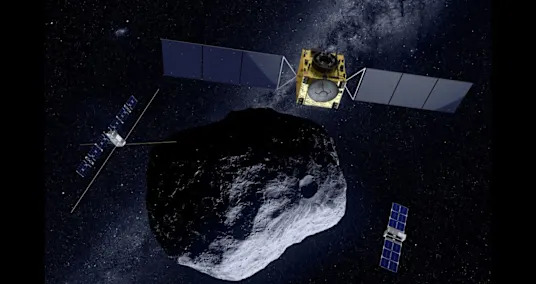
Hera will begin a series of precision burns in October to shift the spacecraft out of its interplanetary cruise phase and set up rendezvous with the Didymos system. The spacecraft and its 12 payloads will spend at least six months studying the system, beginning with early global studies and then deploying its Milani and Juventas cubesats, before then embarking on a more detailed mapping exercise. The primary mission will culminate in an experimental, close-up inspection of the DART impact crater from an altitude of around 1 kilometer (0.62 miles).
The aim of the series of detailed follow-up studies of Dimorphos is to help transform DART's one-off kinetic impactor experiment into a repeatable, scalable asteroid-deflection method.
While humanity's knowledge of our solar system's small worlds is slowly growing thanks to missions from across the globe, such as NASA's OSIRIS-REx (now OSIRIS-APEX), JAXA's Hayabusa2 and China's Tianwen-2, Hera will also be performing the first survey of a binary asteroid system.
Scientists recently revealed that DART slamming into the 560-foot-wide (170 m) Dimorphos also altered the orbit of Didymos, the much larger asteroid of the pair at roughly 2,788 feet (850 m) across. This unexpected outcome could provide new insights into binary asteroid systems and, crucially, how their orbits change after impacts.
LATEST POSTS
- 1
 'Sex and the City' star Kim Cattrall marries longtime partner Russell Thomas in intimate London wedding
 - 2Find the Historical backdrop of Common liberties: Advancing Equity and Equity Around the world
- 3'The Beast in Me' arrives on Netflix: Is it based on a true story? And what drew Claire Danes to it? What to know about the thriller series.
- 4What to expect from the planets in 2026 — key dates and sky events
- 5Is relief in sight? Flu season still brutal but cases are declining.


- High velocity Internet services for Metropolitan Regions
- April full moon 2026 dazzles as 'Pink Moon' lights up skies worldwide (photos)
- How color-changing, bacteria-infused spacesuits could help keep future astronauts safe from space radiation
- Katz to Hezbollah chief Qassem: You won't live to see Israel’s full response to Passover attacks
- Well known SUVs With Low Energy Utilization In 2024 vote
- German finance minister sees advantages of smartphones in schools
- A definitive Manual for the 5 Off-road Bicycles Available
- Should you get an RSV vaccine this fall? What to know and where to get a shot
- Opening Monetary Information: Your Exhaustive Manual for Finding out about Individual budget