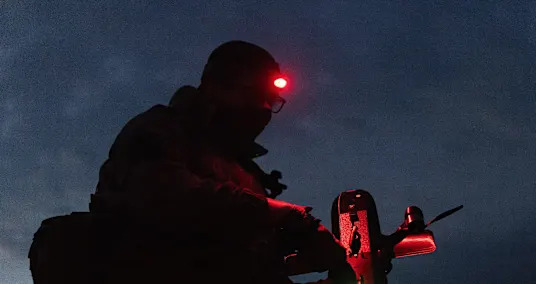
Ukraine has demonstrated its ability to rapidly adapt to a changing battlefield.
A top NATO commander said the Western military alliance needs to be able to do the same.
Part of this means fast-tracking new war technology.
A top NATO commander has said Ukraine's battlefield adaptation is impressive and that the alliance needs something like an "HOV lane" to fast-track new war tech.
In its four years of fending off Russia's full-scale invasion, Ukraine has demonstrated an "adaptation DNA," Adm. Pierre Vandier, NATO's Supreme Allied Commander Transformation, told Business Insider.
"That means that they've been very good at solving the problems at a very high speed. We haven't been accustomed to do that for decades," said Vandier, who oversees modernization efforts. He added that he wants NATO to adopt a sense of urgency in developing and procuring new weaponry like Ukraine has done.
The Western warships, aircraft, and armored vehicles that have dominated in past wars often take several years to build; the process can be even longer for newer designs.
The war in Ukraine has been defined by the overwhelming involvement of drones, robots, and other emerging technologies that move from the design phase to field testing and eventually into the hands of soldiers on a much quicker timeline.
In some cases, that process takes only weeks or months — any slower, and the product may become obsolete.
New tactics and countermeasures are evolving rapidly as well. For instance, early in the war, Ukraine had limited options to fight Russia in the Black Sea, so it created a fleet of exploding naval drones. When Moscow responded to this development by increasing combat aircraft patrols in the region, Kyiv armed the drones with surface-to-air missiles.

Senior Ukrainian officials have described the arms race as a cat-and-mouse game. NATO isn't driven by the same wartime pressures; however, officials and security experts argue it can't afford to relax.
Vandier said the war in Ukraine has demonstrated that the defense industry moves at two speeds: one for bigger, more complex systems, where development cycles last years, and another where necessary adaptation occurs every few weeks based on direct feedback from combatants.
The latter doesn't exist in the West, Vandier said. He compared the situation to a highway, explaining that the fast track is stuck behind a slow track. NATO needs "an HOV lane" for war technology so it moves at speed instead of getting stuck in traffic, he added.
NATO leadership recognizes it needs to change how it approaches the development of new tech and create a strong demand signal for industry. A challenge is that some legacy defense contractors remain focused on older procurement models, though newer startups are trying to more closely emulate Ukraine's industry.
"They want to enlarge the highway but not build the HOV," Vandier said of current NATO defense procurement efforts. So more of the same — more cars and more traffic jams. We need a fast track."
NATO officials like Vandier have long praised Ukraine's ability to adapt rapidly to changing battlefield dynamics. However, security experts have criticized the alliance for its sluggishness in preparing for modern warfare and for failing to address some of the threats seen on the battlefield.
"We need to apply a new model to understand what's going on, not only in Ukraine. It's the difference you have between a crisis and a shock," Vandier said.
In a crisis, he said, "you just want to reestablish what was broken or dysfunctional, and you go back to the previous model. When you are in shock, you need to invent something else because what you have in hand is not sufficient."
Read the original article on Business Insider
LATEST POSTS
- 1
 VPN Administrations for Online Protection
- 2Ryan Gosling responds to Deidre Hall's invitation to visit the 'Days of Our Lives' set: 'This is a very enthusiastic yes'
- 3California is completely free of drought for the first time in 25 years
- 4After toilet and email issues, Artemis II astronauts fire engine to head for the moon
- 5Vote in favor of your Number one Kind of Shades





- The most effective method to Pick The Right Speakers
- Pick Your Favored kind of salad
- Gaza amputees struggle to rebuild lives as the enclave faces shortages of prosthetic limbs
- Pilot captures jaw-dropping northern lights show from 36,000 feet (photos)
- Doritos and Cheetos debut 'NKD' options, without artificial colors or flavors
- What's inside Mexico's Popocatépetl? Scientists obtain first 3D images of the whole volcano
- 'A perfect storm': Airlines cut flights and increase airfares as jet fuel price spikes
- Former United Launch Alliance CEO Tory Bruno joins competitor Blue Origin for national security projects
- Eating Brie, Gouda, cheddar may lower dementia risk, new study says