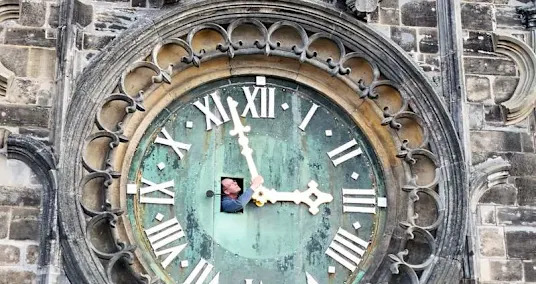
Clocks across the majority of European countries are set to go forward by one hour early on Sunday as the continent moves to daylight saving time, also known as summer time.
Clocks in most European nations including Germany advance by one hour at 2 am (0100 GMT) to 3 am, heralding longer evenings and brighter days.
This means that for the coming months parts of Europe will be on Central European Summer Time (CEST), before moving back to Central European Time (CET) in the autumn, when clocks go back again by an hour on October 25.
The aim of the change is to make better use of daylight in the shorter days of the winter in the northern hemisphere.
The signal for the automatic changeover of the clocks in Germany comes from the Federal Institute of Physics and Metrology (PTB) in the northern city of Braunschweig, also known as Brunswick in English.
The institute's experts ensure that radio-controlled clocks, station clocks and many industrial clocks are supplied with the signal via a long-wave transmitter called DCF77 in Mainflingen near Frankfurt.
LATEST POSTS
- 1
 The largest sun of 2026 rises today as Earth draws closest to our parent star
 - 2Untamed life Safe-havens All over the Planet Offering Remarkable Creature Experiences
- 3Influencers are selling a delusional fantasy of being postpartum. Why is it so easy to believe?
- 4Relive NASA's historic Artemis 2 launch to the moon in these stunning photos
- 5A hunger for new experiences Narratives: Motivating Travel and Experience



- Rediscovering Experience Through Excursions: Individual Travel Stories
- Brazil Passes Law to Use Seized Bitcoin, Crypto to Fund Public Security Measures
- A Pompeii site reveals the recipe for Roman concrete. It contradicts a famous architect’s writings
- China Just Got A Lot Closer To Its First-Ever Manned Moon Landing
- Holiday spots Well known With Americans In 2024
- January’s full wolf supermoon and the Quadrantid meteor shower will start off the new year
- 10 Hints for an Effective New employee screening
- Hunger and makeshift shelters persist in north Caribbean nearly 2 months after Hurricane Melissa
- Hundreds show fascist salute at rally in Rome in annual ritual