When you buy through links on our articles, Future and its syndication partners may earn a commission.

For the first time in more than 50 years, humans are cruising through lunar space.
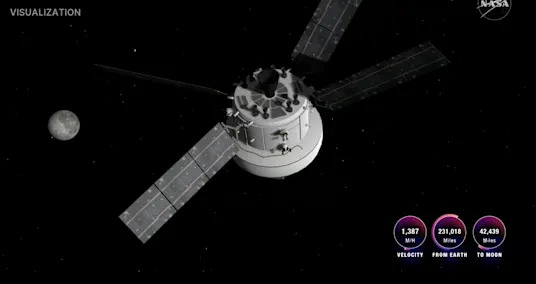
The four astronauts of NASA's Artemis 2 mission arrived in the moon's sphere of influence — the region where lunar gravity exerts a more powerful pull than that of Earth — today (April 6) at 12:37 a.m. EDT (0437 GMT).
The milestone occurred when the mission's Orion capsule was about 39,000 miles (62,764 kilometers) from the moon and roughly 232,000 miles (373,368 km) from Earth, a commentator said during NASA's Artemis 2 livestream.
The Artemis 2 astronauts — NASA's Reid Wiseman, Victor Glover and Christina Koch and the Canadian Space Agency's Jeremy Hansen — are the first people to cross the lunar threshold since December 1972, when the three-person Apollo 17 moon-landing mission did so.
Artemis 2 will not touch down on the moon, or even enter lunar orbit. Rather, Orion will loop around the moon's far side this evening in a history-making flyby. During that encounter, Artemis 2 will get farther from Earth than any crewed flight ever has.
The distance record is currently held by the Apollo 13 astronauts, who got 248,655 miles (400,171 km) from our planet in April 1970. At the height of tonight's flyby, just after 7 p.m. EDT (2300 GMT), Artemis 2 will be 252,757 miles (406,773 km) away from the rest of humanity, NASA officials have said.
The Artemis 2 astronauts will study the moon during the flyby, gathering data that could help scientists better understand the terrain and geology of Earth's nearest neighbor. They'll also be treated to a total solar eclipse, which will not be visible to those of us here on terra firma.
In addition, the flyby will chart their path home: Lunar gravity will slingshot Orion back toward Earth. Artemis 2 astronauts will come home on Friday (April 10), ending their 10-day mission with a parachute-aided splashdown off the coast of San Diego.
Editor's note: This story was updated at 1:15 a.m. EDT on April 6 with NASA's revised time of Orion's entry into the moon's sphere of influence — 12:37 a.m. EDT rather than 12:41 a.m. EDT.
LATEST POSTS
- 1
 Congress is running out of time to extend ACA subsidies as the GOP moves on to an alternative plan. Here's where things stand.
 - 2The gay hockey show no one saw coming — and everyone is suddenly obsessed with
- 3NASA’s Pandora telescope will study stars in detail to learn about the exoplanets orbiting them
- 4In a first, scientists observe a comet reversing its spin
- 5A Lone Wolf Outsmarted Hunters in the Black Forest and Then Vanished




- Greenland’s melting ice and landslide-prone fjords make the oil and minerals Trump is eyeing dangerous to extract
- 5 things for parents to know about changes to kids vaccine schedule
- Landslides triggered by heavy rainfall kill at least 20 people in Tanzania
- Best Augmented Simulation Ride: Which One Feels Generally Genuine?
- Tanzania president remorseful over internet shutdown on election day
- Figure out how to Separate Among Fledgling and Master Fender bender Legal counselors
- Impact of NIH funding reductions felt in cancer and infectious disease trials
- The Best Competitors of the 21st Hundred years
- People who talk with their hands seem more clear and persuasive – new research