When you buy through links on our articles, Future and its syndication partners may earn a commission.

The sungrazing comet C/2026 A1 (MAPS) has been causing a stir in recent months as it brightened during its headlong rush towards the sun, which culminates in a high stakes close approach known to astronomers as perihelion on April 4. Here's how you can watch its final do-or-die approach for yourself through the technological eye of a sungazing spacecraft.
C/2026 A1 (MAPS) is thought to belong to the Kreutz family of comets — enigmatic solar system wanderers that are thought to have a shared progenitor and whose orbits take them perilously close to our parent star.
At perihelion, C/2026 A1 (MAPS) is expected to pass just 101,100 miles (162,700 km) from the sun's photosphere — a passage that could either spell its doom as volatiles buried beneath its surface vaporize and undermine its integrity, or may even see it shine bright enough to appear in the daytime sky.
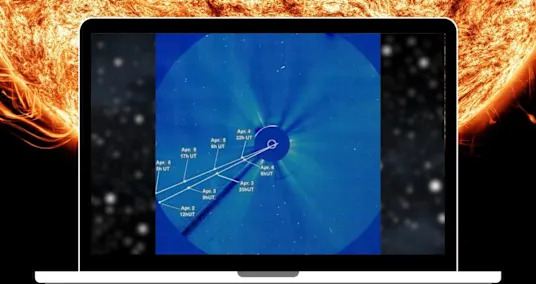
Either way, you may be able to spot the wandering solar system body as it careens towards the sun in imagery captured by the Large Angle Spectrometric Coronagraphy (LASCO) mounted on the joint ESA/NASA Solar and Heliospheric Observatory.

LASCO was designed to take detailed images of the sun's atmosphere by blocking out the light coming directly from its surface. Each of SOHO's "C3'" images captures a field of view 32 times the diameter of the sun, revealing how material ejected from its surface interacts with the space environment and, occasionally, detecting the presence of interlopers, such as C/2026 A1 (MAPS).
Space.com columnist Joe Rao forecast that comet C/2026 A1 (MAPS) will enter the LASCO instrument's field of view from 8:00 a.m. EDT (1200 GMT) on April 2 through to 1:00 a.m. EDT (0500 GMT) on April 6. It will briefly disappear as it passes into the blind spot created by the instrument's occulter disk for the four hours surrounding periohelion, before emerging back into LASCO's field of view, assuming it survives the close brush with our parent star.
LATEST POSTS
- 1
 Artemis II updates: NASA's moon mission breaks Apollo record for farthest distance humans have traveled from Earth
 - 24 astronauts are now on their path to the moon. Here’s what happens next
- 3UB professor shares his experience on almost becoming an astronaut
- 4Is Chinese food truly flavorful?
- 5Trump signs bill allowing whole milk to return to school lunches


- IDF kills senior PIJ Gaza City Brigade cmdr. who infiltrated Kibbutz Nahal Oz on Oct. 7
- Aid sent by ambulance to Ukraine front line
- A definitive Manual for the 5 Off-road Bicycles Available
- Compassion and Association: Building Significant Connections
- IDF strikes Shiraz petrochemical site, releases footage of attacks on Iranian air defenses
- Opening Achievement: 8 Methodologies for Compelling Using time productively
- The Best Computer games Ever
- Artemis II's moon-bound astronauts capture Earth's brilliant blue beauty as they leave it behind
- James Webb Space Telescope watches 'Jekyll and Hyde' galaxy shapeshift into a cosmic monster